
Trust Networks
Vol. 3, No. 33

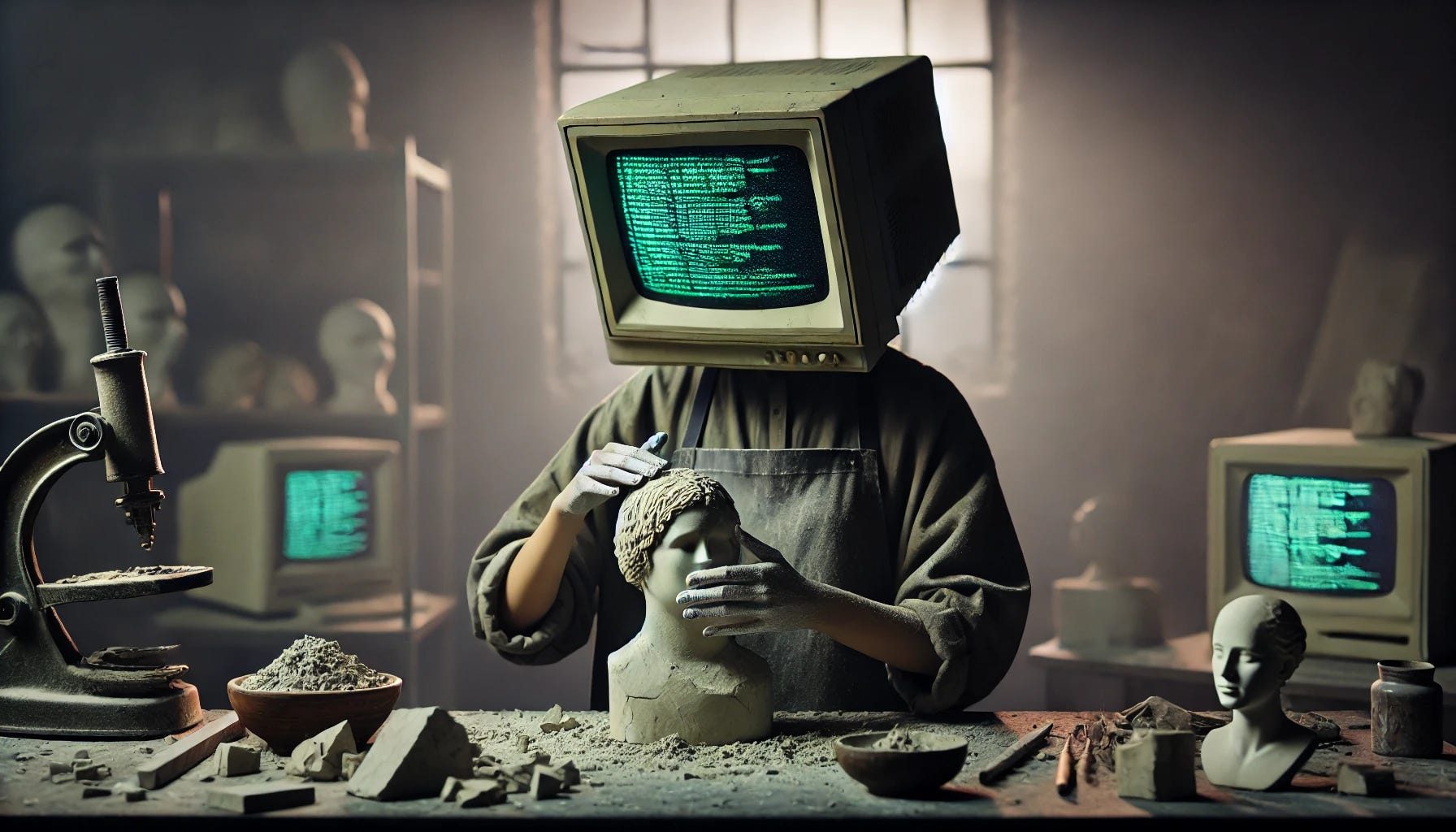
AI gives us digital blocks of marble. What we carve from them will depend on our care, not the code.
They say you will not be replaced by AI, but by someone using it. And that person will probably not be someone who spent twenty years building the same expertise you did. For many, that thought is uncomfortable. It lingers behind every conversation about automation and layoffs, creating the quiet fear that the future is already decided.
But the future is still something we can shape. We can choose to explore rather than withdraw. By experimenting with AI, by testing what it does well and where it falls short, we begin to build new instincts. This may be the first time in history that a technology spread not through institutions or companies, but through individual curiosity. People are not waiting for permission to learn. They are discovering what it can do and finding their own ways of using it.
AI is often seen as something that removes the human touch, yet in practice it highlights how much that touch still matters. In a world where almost anything can be generated, the rare thing becomes the signal of care. We begin to look for traces of presence. We start paying attention to who is behind the words, who is shaping the work with intention. That awareness forms the beginnings of trust networks, small circles of creators and thinkers who share their work with honesty and care.
Michelangelo believed that every block of marble held a living form waiting to be revealed. With hammer and chisel, he brought out what was already within, shaping David and Pietà through patience and faith in the unseen. His art was an act of listening to the material, a conversation that brought form to life.
AI gives us digital blocks of marble. Inside them lies unshaped knowledge and fragments of human thought. They remain silent until someone begins to carve, choosing what to bring forward and what to leave behind. In that act of shaping, data becomes meaning and meaning becomes connection.
The more people create with attention, the more these acts begin to link together. Trust grows between creators and readers, between people who make and those who witness. What begins as personal experimentation becomes a web of relationships built on presence and integrity.
Perhaps this is where all of this is leading. Not to a world ruled by automation, but to one held together by trust. A world where meaning flows between people, with platforms serving the connection instead of steering it. Where each creation carries a trace of the person who made it, and where what matters most is the quiet connection of knowing who we can trust.
Trust Networks as Antidote to AI Slop
Relying solely on what we personally trust would be impractical. There are only so many people I have met and learned to trust to a reasonable degree. Limiting my options to hiring only among them, reading only what they create, doing business only with them, etc., would be plain stupid. So how do we balance our necessarily limited trust circle with the realities of untrustworthiness boosted by AI capabilities? Elementary. Trust networks.
Pawel Brodzinski | 12 Minutes
Humanity, Meaning and Work in an Agentic Age.
Unsaid but not far from peoples’ minds are questions of meaning, purpose and role of humans and our own future. Many people are wondering whether they are building and training the wood chip machine that they will be put into. Most are realizing that we need to upgrade our skills, build our networks, manage our balance sheet so we have options and not depend on our company. We are headcount in a highly competitive client focussed profit maximizing enterprise and not members of a “family.”
Rishad Tobaccowala | 9 Minutes
When execution gets easy, taste gets harder
The hard part about execution getting easier is that it exposes everything else. You can’t hide behind craft anymore. But if you’re willing to expand into the space that opens up, to develop taste, judgment, and conviction, this is actually the most interesting time to be a designer. The role isn’t shrinking. It’s just becoming more obvious who’s actually filling it.
Anton Sten | 5 Minutes
AI at Home and Work - All Things Product with Teresa & Petra
I love that you’re bringing this up because this is why usage at home helps us build our toolbox. The more we use it, the more we learn what it’s good at, what it’s not good at, where context becomes a limitation, we hit context windows, we have to get good about providing the right context and no more. One of my stories is about using it for meal planning. It turns out if I don’t give it my meal preferences, I’m not going to like its meal plan. That’s a great use case for learning how to give it the right context.
All Things Product with Teresa & Petra | 24 Minutes
Wonderful issue my friend. I think you are seeing correctly. If not, you're at least painting something of value to strive for. Thank you.